
Higher Education has Trust Issues
Community partnerships are an important part of the answer

Many people in the US have lost confidence in higher education. They see it as too expensive, too inaccessible, a contributor to the harsh inequalities in our country rather than part of the solution. Community engagement — partnerships between colleges/universities and the larger communities they are a part of — is key to rebuilding that confidence.
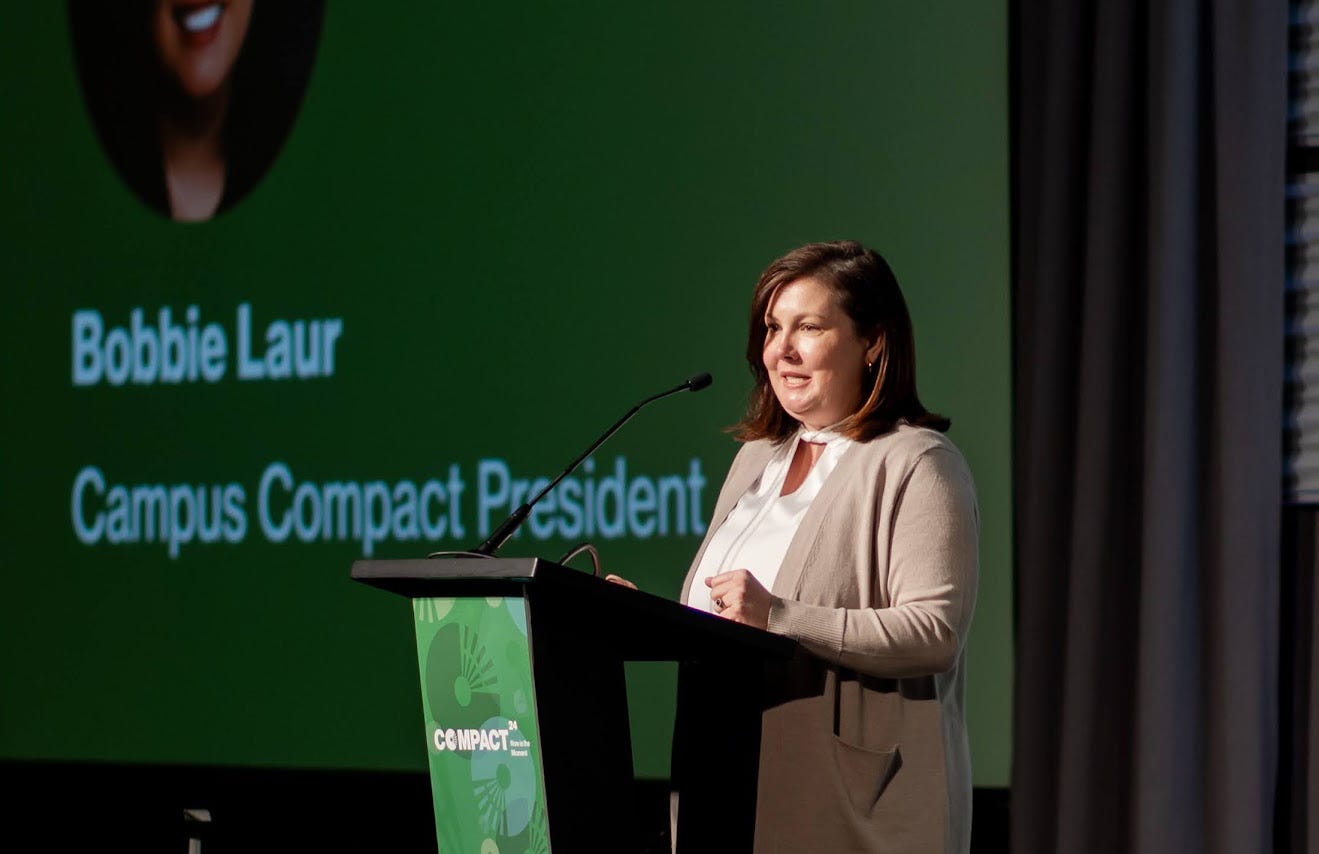
This is what Bobbie Laur and I talked about when I interviewed her for the most recent episode of Partnership Work: From Isolation to Action. Bobbie is president of Campus Compact, a national coalition of over 300 colleges and universities. Since the mid-80s, Campus Compact has been working to advance the public mission of higher education. They empower campuses to partner with communities and address real-world issues together.
I invited Bobbie on to discuss what our political moment means for the work of community-campus partnerships. In our conversation, Bobbie dissects the loss of confidence in higher education and describes how community engagement can serve as a “trust infrastructure” for campuses. She shares her own journey into partnership work and points to examples of campuses where engagement is not just an add-on, but instead is integrated across the institution. And she offers a peek into some of the federal advocacy work that Campus Compact is building towards.
What follows is an edited transcript of our conversation. All our episodes, transcripts, show notes, and more can be found at https://partnershipwork.org.
Paul:
2025 was obviously a hectic, one-of-a-kind year for higher ed. The administration came in really strong with its attacks focused on elite institutions but also more broadly around DEI, research funding, even threatening the nonprofit status of universities. I want to just get your perspective.
If you can put yourself back in that: how did that hit you when it first started coming down? What were you seeing in higher ed, particularly the community engagement part of higher ed, as all of that was starting back in January, February, March last year.
Bobbie:
My honest answer, Paul, is that not all things are created equal in that. The early executive order around diversity, equity, and inclusion wasn’t a surprise to me. I mean, I think the broad sweep of it was, but we saw a lot of that in Trump 1.0.
I’ve been at Compact four years this month and prior to this role I really wasn’t very involved in the federal policy space at a significant level. So it’s been a quick introduction. And it happened in parallel with when we saw a lot of anti-DEI efforts across this country. So really, that executive order in January 2025, for me, was not the surprising piece of the puzzle.
However, I remember being shocked in January 2025 when we saw the federal funding freeze. Since then, particularly when you look at that January to September/October, when the compact from the administration hit the streets, I think it was just a churn. Like you said, it started with the federal funding freeze. And then it was there was a little bit of give on that. And then it was an attack on accreditation. It was an attack on student status around immigration and international students.
It’s just been a lot to keep up with. Some of that, to be honest, I have been surprised by. Higher education writ large has been something that Republicans and Democrats have long understood the value of. It’s one of the greatest strengths of our country. It’s something we are regarded about around the world, and I think in the sector we thought we were a lot safer than we have turned out to be, particularly in terms of the research enterprise. I think we all felt this is where the most innovative scientific discovery happens in the world and that no one in their right mind would be coming to destroy it.
Paul:
You mentioned the Compact. So, that’s the Compact for Academic Excellence in Higher Education, which the administration put out. It brought together a bunch of different critiques of higher ed into a list of priorities that universities and colleges would be asked to align with in order to get preferential treatment for funding.
I know you mentioned last time we talked that having it called a “compact” was a bit problematic for you all over at Campus Compact.
Bobbie:
Yeah, yeah, not ideal wording, not ideal wording at all.
Paul:
There was a ton of pushback on it, obviously, from higher ed, with people raising issues of free speech, academic independence, autonomy. And I think at this point none of the original institutions signed it. There are a couple of small conservative colleges that have signed on to it, including the one Ron DeSantis overhauled in Florida. But it’s still evolving. It’s still out in the world there and potentially could come back in another form once they get feedback on it.
You wrote a really interesting piece right after it came out talking about the work of Campus Compact. It was called A Higher Education Compact in Action. You put it out on the Campus Compact website.
And I was intrigued by your take on it because you kind of reframed things. You shared that you agreed with many of the concerns about government overreach, but you argued that we can’t be in defensive mode around this. And I specifically want to quote you here and I ask you sort of how your thinking may have evolved. So you said:
“The value of higher education is under question. While it is tempting to dismiss the loss of public confidence as partisan, narrow-minded, short-sighted, or just a messaging issue, we need to take it seriously. It’s a trend that has been building over years and is based on valid and wide-ranging concerns.”
Before we get to the solutions you pointed towards, I wanted to ask you, what do you see as the valid and wide-ranging concerns in higher ed that we need to be really paying attention to?
Bobbie:
Yeah. And, I would stand by that quote still today. I think those feelings really still ring true for me. I’ve spent a career in community engagement, as have you. I think that the people that do this work day and day out, I think that that probably resonates a lot with those of us in community engagement.
And what I mean by that is we are often the people who are sitting on our campuses really trying to walk a line of saying, “There is harm. There is potential harm. The universities are not getting everything right.” We are the problem solvers.
We have seen the confidence numbers in higher education falling for years. That’s part of where I think created this really challenging landscape for us. While we were being attacked, we weren’t necessarily in a time where broadly, across the country, we had everybody coming to our defense. You asked what are those reasons where I’m saying, “We have to look in the mirror?”
There’s real financial ones. Affordability is always the number one reason that people have questions about confidence in higher education. We have a student loan debt crisis in this country. Many people are priced out of getting a college education. And there’s lots of interesting, innovative solutions, particularly around community colleges but the price of higher education, by and large, has skyrocketed.
At the same time, we have massive increases in wealth equity gaps across this country. So we are experiencing a time as Americans where the rich are getting richer and the poor are getting poorer. And when you have a higher education system that’s talking about economic and social mobility a lot, I think we need to look in the mirror. Yes, there are campuses that are excellent at economic and social mobility. But, writ large, what’s the responsibility of the sector in the broader distribution of wealth in this country?
And I think that has caused a lot of middle America and folks that aren’t pursuing degrees in higher education to begin to feel very separate from this institution that feels elitist, contributing to something that they don’t feel is accessible to them. You know, when you look in rural America, that is increasingly true. The demographics of these confidence questions along political lines are stark, and also around geography, around the urban-rural divide.
I actually was just on a panel two weeks ago at AAC&U around advancing public trust and I was asked a question about this. And I don’t have this really well tuned, but there’s something for me that I’m sitting with. The work that I have spent my career doing has really been about making the case that higher education is essential to our communities. We are drivers of not just economic development, but community well-being and health equity and what it means to create thriving communities for all. Because there’s so much that we do as colleges and universities that is beyond the students that walk through our doors and get degrees.
And I think we have to take stock of the fact that so many people are suffering. They don’t have access to healthy food. They aren’t finding ways to find affordable housing. They’re not able to find jobs that provide living wages. We have a climate change. We have a mental health crisis across this country that’s the worst it’s ever been.
Why would we expect society to be super confident if we’re yelling from the rooftop that colleges and universities are essential anchors in our communities, that they are critical to how our society functions, and society is not functioning very well for the average person. That, I don’t have the exact data points on, but I think that is playing into it. I don’t think that we understand how to ask that question.
Paul:
As you said, people in community engagement are many of the people who have been pointing out flaws in higher education. But now with these attacks there is an urge, I think, for many people to sort of hunker down and be defensive and not engage in those conversations because they’re not necessarily good-faith, productive conversations. And so it’s hard to figure out how to navigate these larger debates without without falling back into total defensiveness.
How do you navigate that? How do you think we collectively should be thinking about that tension?
Bobbie:
I’m definitely not on the side of “we don’t need to be defending ourselves.”
And frankly, I don’t know that a lot of people think we’ve effectively defended ourselves — ourselves being higher education — as a sector this year. There’s a typology that I’ve heard of, when you’re trying to address a moment like this, of the multiple roles that need to be played.
You need bridgers, you need builders, and you need blockers.
The blockers, particularly in this case, the biggest strength we have had has been the legal community. Organizations Democracy Forward, that I don’t think most folks had heard of a year ago, have been essential. Utilizing our justice system to be able to call out, “Is this constitutional or not?” whether it’s endowment taxes or whether it’s federal funding freezes or whether it’s using executive orders in certain ways. You need people that are doing the blocking work.
What I’m trying to argue is that we can’t just be defending a status quo. There are real things that need to shift in higher ed. We need folks who can also help build for what comes next. How do we actually build a more inclusive, more accessible, more thriving higher education system?
And then you need bridgers, people that can connect the dots, people that can do a better job of making sure higher gets out of being such a siloed sector. I actually believe that higher education institutions, particularly those who are deeply civically and community engaged, are well positioned to be builders and bridgers.
And then I think organizations and coalitions like Compact and others that are in this space, we’re particularly attuned to do that within the broader ecosystem of higher ed. So, I sit in a lot of tables and a lot of rooms with other organizations in higher ed. And a really big one just launched two weeks ago. It’s a new organization that people should look up. It’s called the Alliance for Higher Education. And it has emerged as a response to what’s been happening in the past couple of years.
It’s led by Mike Gavin, who used to be the president of Delta College. And I’ve been working with Mike along with lots of others over the past couple of years to get to this launch point. And the alliance, to me, is such an important recognition of what we didn’t have before, which is a defense-structured organization. It’s not a membership organization, it’s not beholden to serving our institutions which can create real challenges for some of our higher ed associations. The Alliance is sitting alongside all of the other membership organizations and others, but they are going to be a defense engine. And they’re going to help drive visions for the future. If we’d had an organization the Alliance in place a year ago, I think we may have been able to navigate differently.
Do I think that we would have stopped the bleeding? I’m not sure. But I am excited about something the Alliance coming online and what it might bring in terms of our future ability to work more cohesively as a sector.
My main argument is about not settling for the status quo. It’s also definitely not a throw the baby out with the bathwater moment. This is not a moment where I’m by any means advocating that we just start over. I mean, higher ed continues to be the primary pathway for people to get opportunities for economic and social mobility, to develop critical thinking skills, to meet the needs of workforce. We just have to think about what that social contract look with the public looks like, in a more meaningful way.
I don’t believe there’s really a future for the Trump Compact. And I think the thing that ended up creating real alignment across a diverse set of institutions that received the initial opportunity is this very clear consensus around merit. That there’s a real value on merit when it comes to research funding. Awards should be given to the most competitive and right solutions. And that they don’t want to do anything that is saying, “If I sign this, I’m going to get preferential treatment.”
Some of them were places like UVA that had experienced a presidential turnover or leadership changes that I think made the administration feel they would be more likely to say yes. But all of them ultimately said, even if we agree with some components of this, we disagree on the basis of merit. And I think that stopped the whole thing in its tracks. That’s something that conservatives and liberals agree with.
Paul:
So the compact may have inadvertently created a moment of consensus among institutions that were really struggling with in their individual responses to Trump.
These are obviously big, complicated issues, but what do you see as the role of community engagement in the building role that you just described?
Bobbie: Sometimes we conflate that around confidence and trust are the same thing.
Paul:
What’s the difference between confidence and trust?
Bobbie:
Confidence is: I’m expecting this thing to happen. I’m confident that it is going to happen because there was a promise or I’m paying someone to do something.
Trust is a belief in something. Trust is: I think that this person is honest. I have trust that when they say they’re going to do something, they’re going to do it. Trust is often about people. You can have confidence in institutions and you can have confidence in a product. I don’t think most of us trust products, right? We’re confident that a product is going to deliver us for it. But you have trust in people. You have trust in an elected official or you have trust in your pastor. And the trust can be broken.
Community engagement is relational. It is not an AI bot. Community engagement is not done without people at the center of it, both in terms of the community and the institution. And so I do think, in many ways, rebuilding a trust infrastructure, I think community engagement is at its core. And I think in many ways community engagement can be that trust infrastructure for higher education.
Because it’s where we connect institutions to the people and places whose confidence they need to regain. Community engagement is not a new idea, Hundreds and I believe thousands of institutions are thinking about this work. But there’s a difference between doing it in very transactional ways and really saying, “This is at the center of what we do as an institution.”
And that’s where I think we need to move. The moment calls for us to say this civic and community engagement work needs to be sitting at the very top. Just as we talk about preparing students for the workforce, just as we talk about the economic impact of our institution, we need to be talking about the civic and community engagement work.
And that’s what I think when I think about the building moment. It’s moving beyond, “I have a center that’s doing some great community partnership work, awesome,” or, “We have a minor in civic engagement that we have 30 students enrolled in,” moving to, “We have an expectation that every single student who walks through our doors is going to have an experience of civically-engaged and community-based teaching and learning. That this is something we are embedding in the curriculum.”
It looks promotion and tenure guidelines being rewritten to really value community-based research and scholarship. It looks having a chief community engagement officer at the cabinet level. It looks saying when critical decisions are being made about the institution, we are considering community and civic engagement in that room.
And those are the things that I think are going to make the difference. At Compact, what we’re focused on helping institutions think about in this moment is how we’re going to move forward and how do we rebuild that trust and confidence with putting civic and community engagement at the center.
Paul:
I want to pause on the big picture and talk about you for a minute. What were the early experiences that convinced you that community engagement, or civic engagement, in higher ed was something powerful, something important?
Bobbie:
It’s interesting, Paul, I am one of the few Campus Compact employees that did not do AmeriCorps service. The vast majority of our team at Campus Compact served had some sort of AmeriCorps experience.
That wasn’t a part of my experience. I was a finance major. I did not come up through a high school or collegiate experience grounded in community service. To be honest, I love my upbringing. I’m from the rural Eastern shore. It just wasn’t a part of what was in the water for me.
Where I initially found such passion in higher ed civic engagement was, I was just really involved in student leadership as an undergrad. And I ended up being the student government president my senior year of college. And I was on a campus, Towson University, and that really took serious what student voice and shared governance look like.
So I had experiences serving on the university senate and advancing things like plus-or-minus grading. I built a coalition along with other student leaders to advocate for tuition freezes at the system level. I had a rich amount of time to realize that my voice had agency and that I could make an impact. And at the same time, I learned a lot about the power of higher ed. I was a student leader who spent most of my time in the student government office and working with the president. And I just fell in love with higher education. I was like, “I can’t go out and work for Morgan Stanley.”
I didn’t have any of the language around community engagement at that time. Then, in my first job, I found myself at San Diego State University working in the President’s office at 22. And I had a Chief of Staff who I was working with. And she asked if I wanted to help build a community partners database for the university.
It was a trial by fire. I learned right there and I got to be a part of a team that was trying to understand, “What are all the relationships that exist across San Diego State? Which of these are working with K-12? Are we tripping over ourselves? Are we our partners actually understanding how to navigate the front door?” Some of the same conversations that I think are still really resonant.
And I just really loved it. And so I spent a couple years at San Diego State just full-on immersing myself in this whole new world that I’d never heard of around community engagement. And then I ended up finding an opportunity to come back and work at Towson University as they were just getting off the ground a new division of economic and community outreach.
And in that space, I was able to get involved with organizations like CUMU (Coalition of Urban and Metropolitan Universities), but then also to really, from the ground up, build ultimately what became the community engagement infrastructure at the university. And so, a lot’s changed in the 20 years I’ve been doing this, I mean, back then there weren’t that many centers or institutes, particularly at less-resourced campuses.
We saw student-facing institutes and centers that had been coming up at the time Compact. But when I look now, the centers for community engagement and partnerships that exist at so many of our colleges and universities, most of those have come about in the past couple decades. So I think some of it’s just you kind of are there at the right time, right place.
So for me, I’ve had the chance to build a lot. Most of my career has been spent building things from the ground up and that required early on learning from others, getting to know: What was working at that institution and how can that impact and influence what we’re doing here? We don’t need to reinvent every wheel.
And I was involved with networks from the very beginning when I went to Towson because of CUMU. And so I always had this blessing from at least that time, which was 2006 when I came to Towson. So, 20 years ago. That’s crazy. From that time, I was always carrying this kind of duality of doing the work on campus, but then getting to be in this space of a national network. I always felt it was just this beautiful thing that I get to see what’s working in other places and what’s not working.
And then I also have responsibility of making this happen in my campus and in the community I live in and love. I stayed for 15 years, which was longer than I expected in 2006. But, this work takes time. I think we all know that, too. You can’t do this work quick.
Paul:
Could you share a couple of the projects that you built and just a little bit of the the life of them, the spark of those partnerships that really drove you
Bobbie:
Honestly when folks ask, “Do you really miss being on a campus?” it’s definitely what I miss. This work keeps me very busy, I’m so passionate about the work we’re doing at Campus Compact, but I do miss the direct work with community partners.
I still get a chance to work with faculty and staff all the time, but I no longer work with the community partners. And, I still live here in greater Baltimore.
So, a couple of the things that I look back on and I’m most proud of. Some of them are the small connections that I made that ultimately led to incredible partnerships. Like, just recently I ran into someone at Chuck E. Cheese. Oh my God. It was Chuck E. Cheese, Paul. It was two weeks ago. My nephew who was turning five was having his birthday party and there was another guy there with a five-year-old and he’s a professor at Towson in biology. And I didn’t know him.
And he said, “Where did you used to work?” And I said, “Oh, I used to work in the community engagement space.” And he goes, “Oh, I work with them because I am the research director for this project up in Port Deposit that you probably haven’t heard of.” And I go, “Oh my God, you’re doing the work with the turtles?” And he was like, “Yes, you’ve heard of it?” And I was like “Yes, I was the person who facilitated that whole early project, 10-plus years ago with a biology professor named Richard Siegel.
We had this engaged biology faculty member who had figured out that the northern map turtles were essential to addressing these sediment concerns along a dam. But there was this recognition that this town had become obsessed with these turtles. And so there was this moment of, “Could we do something around ecotourism?” Could this be a thing in this small, rural, not necessarily thriving town called Port Deposit? And this is about 45 minutes to an hour north of Towson University. But that was, to me, that’s what it means to be a metropolitan university. It’s not just about right here. And we built this amazing partnership with the town of Port Deposit. There’s a whole ecotourism facility, schools come and do field trips. And it’s a living, learning lab that’s up there now.
I just was beaming for days after that conversation at Chuck E. Cheese because Richard’s not leading that work anymore, I’m not leading that work anymore, and there’s a whole new generation of people. It centers the best of community engagement. In this work, sometimes it’s about a relationship that you start or an introduction that you can make.
But then also I had a chance to work with one of my biggest mentors and influences in my life ever. Her name is Nancy Grasmick. She was the state superintendent of schools for 30 years in the state of Maryland.
When I was a kid, she was the superintendent. And Nancy was a presidential scholar at Towson, and I had built a program around women’s leadership, and she loved that program. And we ended up having conversations about the deficit of leadership in our communities and just in our business community and our public communities and what would it look for the university to do something really bold.
I ended up getting tasked with building what is now the Dr. Nancy Grasmick Leadership Institute. This institute, I mean, it has a staff of its own and it’s doing the most incredible work to prepare and cultivate and support leaders across the region in all kinds of industries. And so I look at that and I again just beam with pride. I by no means deserve the credit for that, there’s so many people that made that happen but that feels so just so important and relevant.
When I get asked “What drives you?”, I think — and Towson’s a big part of the story — I’ve had a chance to make things happen. And that’s a lot of what community engagement is. When I talk about big bureaucracies exist in higher ed, community engagement is this special little area where because you’re working with community partners who are so resource savvy, and a different set of players, I definitely have had a chance to do things were we dream up an idea, get the right people around the table, and make it happen.
I talk about that with young people. We’re trying to support people coming up through the field now, building a pipeline into it. And I say “Man, this work is really rewarding because you’re gonna get to try things. You’re gonna get to be a part of building stuff.”
Paul:
I love that. That resonates with me too.
I want to follow up on what you said about the future needing a different approach to community engagement that’s really about a core commitment of the entire institution. Can you give me one or two examples of who’s really doing that well?
Bobbie:
Yeah. So for Compact, this is going to be a heavy amount of our work going forward.
The core commitments, the institutional-wide commitments, look different in different places. So context does really matter here. And I think we have a new grant from the Luce Foundation around campus action planning and that’s exactly what this is going to be about. How do we help campuses meet this moment?
But understanding this is not a silver bullet. There’s not this one structure. I think there’s essential pieces I talked about. There’s leadership, there’s resources, there’s process that matter.
A couple of places that come to mind for me, Paul, that I think are kind of showing the diversity of what this can look like are places Weber State University. I don’t know if you know Weber State.
Paul:
Yeah, I spent a decade out in Utah. I know them.
Bobbie:
The reason I say Weber State is, they just have all the pieces there. They have this Ogden Action Collaborative where they’re looking at anchor work in real lockstep with the community. Weber State is the facilitator and convener of this community-led effort that is about economic development and workforce development and housing and just really thinking about how they can create a thriving Ogden, which is the city where Weber State is located. But they also have deep commitments to what this looks in the curriculum.
They have for a long time been leaders with the American Democracy Project at AASCU and really thinking about what civic and political engagement looks across the curriculum and across teaching and learning. And then they have such a rich office of community partnerships that is doing work around community engaged scholarship and understanding what it takes to do faculty development, but then also to validate and be responsive to partners.
They’re one of those campuses that for Campus Compact, for example, they always have their hand up. When we’re like, “Hey, who wants to think about this new project we have that we’re doing right now around environmental stewardship and justice?” They’re like, “We’ll try it.” So they’re also a campus that recognizes that this work has to constantly be supported with innovation and pushing yourself.
And it’s not about a single person. I think that’s important. They’ve had a presidential transition recently. That’s a place where there’s not a part of me that thinks they’re going to lose this in their DNA. And that’s the real test. Does this survive dynamic, sustained, really transformational leaders? Because we have seen other situations where you’ve got a transformational leader who’s out there headlining every major association. They really believe in this work. And when they leave, so do the commitments. And that’s what we need to protect ourselves against in many ways.
Another one that’s a private institution that I would call out is Colby College in Maine. This is a, a more expensive private institution, but it is really focused on what it means to be there for the public good.
They have an incredible amount of partnerships with the city of Waterville, which is a down the road. And they’re looking at big-time economic development issues in Waterville. And I must say, I think we often face this question of, “Do private institutions have the same public responsibility?” And I think Colby is a great emblematic example of “Yes, and here’s how that can look.
They’re also doing incredible work on student learning. Community-based teaching and learning and civic engagement is not a nice-to-have, it’s not something only accessible to this small group of students, but really for every student, every degree. They also have really strong leadership at the top, who’s definitely helping to drive this and I think institutionalize it in the culture.
Those are two, but I could name community colleges. You know, it’s tougher to do at Research 1 Universities. I think there’s some examples, I would say Penn has been an example. But Penn is working through its own challenges right now. It’s been a tough couple years, and I think we’ll have to see, are they able to sustain those commitments that they’ve had? But Penn is definitely an institution that has shown what it looks like to do this at an institution-wide level.
In some ways, it gets harder. The larger the institution, the more complex the bureaucracy, the harder it is to move it forward. Brown is one that I would say, in the more elite Research 1 category, that I think is getting a lot of things right. They have a vice president for community engagement. They have deep work around community scholarship with the Swearer Center. They’re doing a lot on workforce development these days. They were already doing it, and now, even with their deal and agreement with the administration, they’re doing more of it. So I think Brown’s another one that really has the right structures in place to make sure that this isn’t just siloed in one area, but is really prolific across the campus.
Paul:
Yeah, those are great. I appreciate that. I know there’s others you could name, and I’m holding you to just a few, which is probably hard for a national organization.
Bobbie:
And I will say, too, I want to be clear that I didn’t name Towson or some of my other longtime favorite partners. I was trying to name a couple that might not be the ones that jump to everybody’s mind.
Paul:
I appreciate that, too. I’m intrigued by the language that you used in the article you wrote back in October about a “new compact,” a different kind of compact with the country. And recently you mentioned a “new social contract.” What does that mean? What might it look for higher ed, through community engagement work, to have a different kind of compact with America?
Bobbie:
Man, I wish I had the answer on the tip of my tongue for that Paul. I do think that there are interesting conversations taking place around what that could look like. And I don’t think I would do anybody justice to say I have the draft sitting here, let me just send it over to you. I also want to say, I think it would be almost easier to put really good words to paper and try to circulate, for example, a sign-on, “Let’s everybody sign on to these commitments.” I don’t think that’s what this actually looks like.
That’s how we’ve operated as a field for a long time. “Hey, there’s three things that you can say you’re going to do. And if you sign it, then great, we can talk about how a thousand institutions that signed this thing.”
Instead, I think it is about making deep commitments to sustained, holistic, all-in work. And so I think the practice matters more than the presence in this situation. But that doesn’t necessarily get the headlines, right? The headlines that we see in higher ed are driven by these broader scale initiatives that are often “Can we get a thousand campuses to sign on to XYZ?”
And those things can carry weight. They can be galvanizers, right? But I think when I use the frame “we need a social contract” in many ways, this work is so local that that’s the tension point. To do this well, it’s always been hard to talk about it nationally because it really requires such a heavy focus on context. But I think we do have to solve for it.
So I do think that this moment has opened up all kinds of questions and real challenges of recognition that even at an association level, at a sector level, are we really working as well together as we should be? So next week, I’m really excited. It’d be interesting to come back and talk to you after we get through next week.
Next week, we’re going to be in D.C. We’re hosting a policy and impact summit on Wednesday night and Thursday with about 30 campus teams. And so the teams are made up of the president, the senior government relations official, and then the chief civic or community engagement leader on the campus. We’re hosting it in partnership with George Washington University, and we’re looking at using it as a kind of jumping-off space for a new approach of how Campus Compact is going to think about federal advocacy and strategy going forward.
We’re really centering a series of conversations around the role of higher education, both in community-based problem solving and addressing the most wicked issues. But also, really critically in this moment, the preparation of students for their lives. And what does it mean to really ensure that our students are getting through their experience not just with skills that they need for their for job and career, but also making sure that we’re talking actively about the critical role of civic engagement and supporting pathways into public service?
To do that we’re actually going to bring in a couple congressional leaders who are going to be talking about their personal stories. That’s how we’re kicking it off, leaders from across both sides of the aisle talking about the role of civic engagement in getting them to where they are, and the importance of that work, and creating opportunities and access and opening people’s eyes to the opportunities to make a difference. And then we have a series of really exciting conversations on Thursday.
So I very much have that on my mind. That’s a big deal for us next week and is really going to set a stage for where we’re going to go. So we’re planning to come out of that with a roadmap that we’ll be able to share with the field. I think we’ll probably go public with it more late April, early May, but it’s going to hopefully have a variety of opportunities for campuses and individuals to get involved. In this moment where things feel they’re not moving, and I think we’re all frustrated with the lack of response from our leaders both locally and nationally, we’re going to try to cut through some of that next week.
Paul:
Could you give us a preview about how you’re hoping that goes? What kind of ideas are floating around in that conversation?
Bobbie:
For one, how do we build different kinds of coalitions? At Compact, I am really taking stock of the criticisms around political diversity and ideology in our conversations, and figuring out how to create bigger tents. For example, one of the conversations we’re slated to have next week is with a first-term Republican congressman and a first-term Democratic congresswoman. And I think those conversations are attractive to people, right? Because it there’s a lot of common ground around democracy and commitment to civic values and commitment to thinking about how we create opportunity and access for all.
And so I think that’s one of the things that we’re prioritizing for next week, particularly as we think about Congress as an institution. How do we help bring about conversations across both sides of the aisle around some of these issues? We’re hoping, and we’ve been having early conversations, but I think there’s real promise to engage with a group called the Problem Solvers Caucus in Congress that is co-chaired by a Republican and a Democrat and to me represents a kind of match made in heaven around community engagement.
These are the people in Congress who are like, “Look, problems exist, and they don’t have political identities.” Access to food and affordable housing is not a political problem, the people who are dealing with these issues are not there wearing “I’m a Republican” or “I’m a Democrat” on their sleeve. They just want the problem solved, and they want better solutions for their communities. And I think that’s what community engagement is too.
What does it look If higher education begins to work more effectively with groups like the Problem Solvers Caucus? That’s something we’re trying to bring that I think is different.
So much work in higher education when it comes to advocacy is about federal financial aid. It’s about federal research dollars. There are such good people fighting those fights and focusing on those agendas. We’re really trying to be clear at Compact that our agenda is about: how do we advance higher education’s capacity to solve problems in our communities? How do we prioritize higher education’s responsibility around civic engagement and preparing the next generation of leaders? And I think there’s a lot of common ground on that.
And I think that’s, again, why community and civic engagement is a path forward. We know that there is shared interest among both political parties to think about those things. And, there’s a lot of places to start from. We want people in our communities to have access to good jobs. We want hospitals that are being able to serve in rural areas. And being able to have conversations around “What is the role of higher ed in that?” can open up what right now feels like a really polarized, tough environment to function in. So that’s part of what we’re going to start a conversation about next week. By no means hold me to us solving the problems.
But there’s also, some big votes on immigration next week. So we’ll see who actually we’re able to get come, right? Because, there’s a lot of stuff that’s on the plates for everybody.